
What Do I Need on the Final to Pass? (Final Grade Calculator Formula)
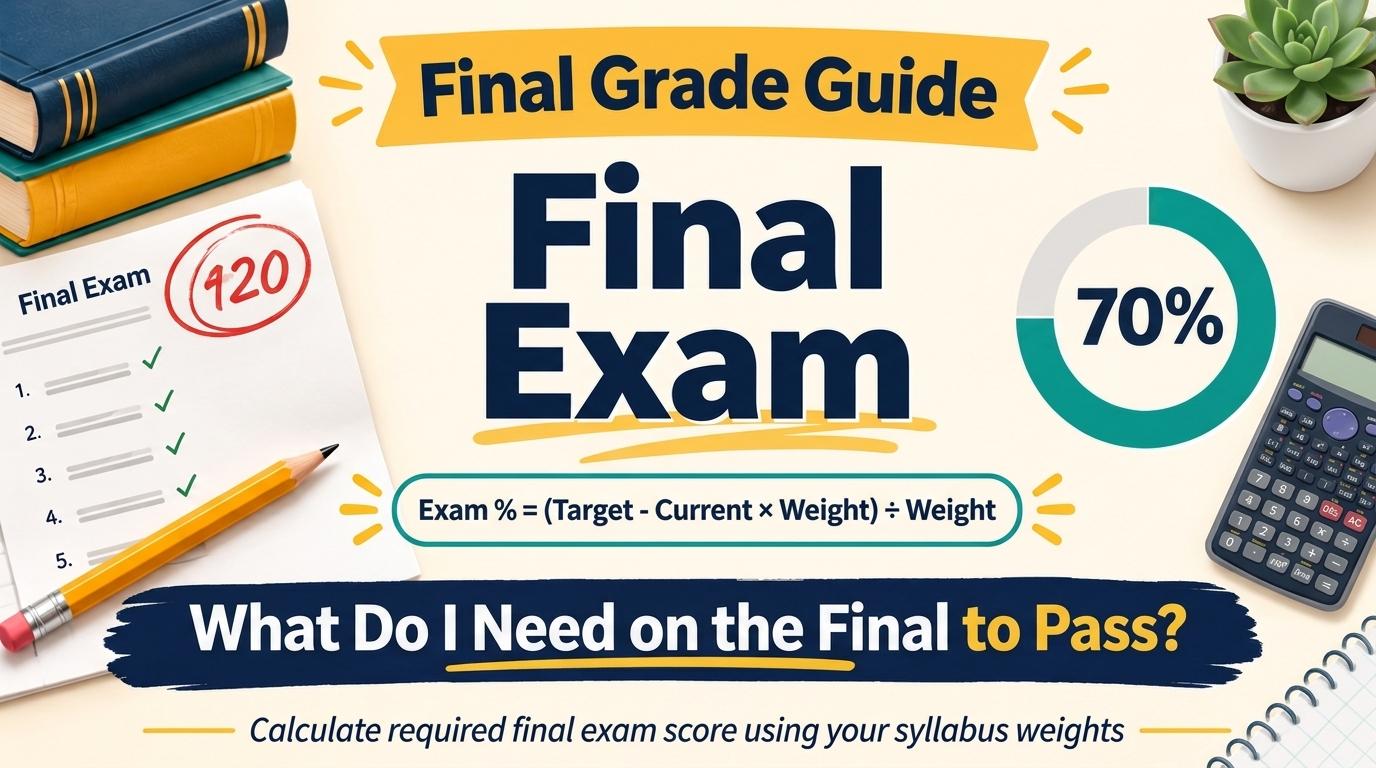
To find the exact score you need on your final exam to pass or reach your target grade, use this formula:
For example, if your current grade is 72%, your goal is a passing 70% (C), and the final exam counts for 20% of your grade, you need at least a 62.0% on the exam.
Final Exam Grade Calculator
Your total standing before the final exam.
Score needed on your final exam to achieve 80% overall:
You need to score at least 88.00% on the final exam. Because the final is worth 20% of your course, focused preparation will put this goal well within reach.
The Final Grade Formula Explained in Plain English
Every final exam calculation comes down to a weighted average. When an instructor says your final exam is worth 20% of your total grade, it means your existing coursework (homework, quizzes, and midterms) accounts for the remaining 80%.
To figure out what you need on the exam, you work backward from your target grade in three straightforward steps:
Multiply your current grade percentage by the weight of all work completed so far: Current × (1 - Weight).
Subtract those points from your goal: Target Grade - Current Points. That tells you how many points the final exam must contribute.
Divide the remaining points by the final exam's decimal weight to get your required percentage score.
Step-by-Step Calculation: A Real Student Example
Let's look at a realistic student scenario. Suppose Alex is heading into finals week with the following numbers:
- Current Grade: 78% (high C+ / borderline B-)
- Target Grade: 80% (solid B on the grading chart)
- Final Exam Weight: 25% (0.25 in decimal form)
Here is how the arithmetic works step by step:
Alex needs an 86.00% on the final exam to secure a final course grade of 80% (B). If Alex scores below 86%, their grade remains in the high C+ range; if they score 86% or above, they officially secure the B.
Scenario Cheat Sheet: What Score Do You Need on Your Final?
Final exams usually count between 15% and 40% of a course grade. Here is a quick reference table showing common starting grades, targets, and what score is required on the final:
| Current Grade | Target Grade | Exam Weight | Score Needed | Difficulty |
|---|---|---|---|---|
| 72% | 70% (C Pass) | 20% | 62.0% | Easily Achievable |
| 68% | 70% (C Pass) | 20% | 78.0% | Achievable with Study |
| 78% | 80% (B) | 20% | 88.0% | Focused Effort |
| 85% | 90% (A) | 20% | 110.0% | Needs Extra Credit |
| 65% | 60% (D Pass) | 25% | 45.0% | Low Pressure |
| 74% | 80% (B) | 25% | 98.0% | Tough, but Possible |
| 62% | 70% (C Pass) | 30% | 88.7% | Major Effort Needed |
| 82% | 80% (B) | 30% | 75.3% | Comfortable Buffer |
| 55% | 60% (D Pass) | 40% | 67.5% | Comeback Potential |
| 75% | 80% (B) | 40% | 87.5% | Realistic Target |
Notice how higher exam weights give you more leverage: when a final is worth 40%, you have much more room to pull up a struggling grade than when the final is only worth 15%.
What If You Need Over 100% on the Final Exam?
If you run the calculation and discover that you need a score like 108% or 125%, don't panic. It simply means that with standard uncurved grading, reaching that particular letter grade is no longer mathematically possible.
Here are three practical steps to take if you find yourself in this situation:
If an A (90%) requires 108%, check what you need for a solid B (80%). Often, you only need a very achievable 65% or 70% to lock in the B.
Some professors offer bonus questions on the final exam or apply a standard bell curve. A 92% raw score on a curved test might be entered as a 98% in the gradebook.
Check your syllabus to see if your instructor drops the lowest quiz or assignment score at the end of the term. Dropping a single 0 or 40% quiz can instantly raise your baseline average by several points before the final is even factored in.
What If the Calculator Says You Need a 0% or Negative Score?
If the formula produces a score of 0% or a negative number, congratulations: you have built up a mathematical safety cushion. Even if you turn in a completely blank test, your current accumulated points already surpass the minimum threshold for your target grade.
Important Warning: Always check your syllabus policies. Many universities and high schools have an explicit clause stating: "Students must sit for and submit the final exam to receive course credit." Even if you only need 10 points to pass, skipping the exam entirely can result in an administrative incomplete or automatic failing grade.
Weighted Categories vs. Total Points: Know Your Syllabus
Before running your final exam calculations, verify which grading system your school uses:
Assignments have fixed category percentages (e.g., Homework 20%, Quizzes 20%, Midterms 30%, Final 30%). In this system, you use the final grade formula shown on this page because the final has a dedicated percentage weight regardless of how many questions it contains.
Every assignment earns points toward an overall sum (e.g., 500 total points in the course, where the final exam is worth 100 points). To find what you need, simply subtract your earned points from your target points. For example, if you have 310 points and need 350 for a C (70% of 500), you need 40 out of 100 on the final.
Smart Finals Week Strategy: How to Hit Your Target Score
Once you know the exact percentage you need, organize your study hours based on mathematical leverage rather than emotional stress:
- Triage your exams by need: If you need a 55% in Psychology to keep your B, but an 88% in Chemistry to avoid dropping to a C, allocate 75% of your study hours to Chemistry. Don't spend equal time on every subject.
- Use active recall over passive reading: Testing yourself with practice problems and flashcards yields twice the recall of re-reading textbook chapters. If you are short on time, check our proven guide on cramming for a test efficiently.
- Check test question point values: Use our teacher grading calculator to understand how many questions you can miss on a 40-question or 50-question test while still staying above your required threshold.
- Check your GPA impact: Curious how this grade changes your cumulative standing for college admissions or dean's list? Calculate your overall semester standing with the college GPA calculator.
Frequently Asked Questions
What is the formula to calculate what you need on a final exam?
The standard formula is: Required Final Score = [Target Grade - (Current Grade × (1 - Final Exam Weight))] ÷ Final Exam Weight. Ensure all numbers are in decimals or percentages consistently.
What is considered a passing grade on a final exam?
In most US high schools, 60% (D) is the minimum to earn course credit, while 70% (C) is standard in college courses and for prerequisites. Check your specific course syllabus for exact cutoffs.
Can you pass a class if you get a zero on the final exam?
Yes, if your grade leading into the final is high enough and the final exam weight is low. For example, with an 88% average and a 20% final, a zero gives you a 70.4% overall (a passing C). However, some instructors require students to take or pass the final exam to pass the course regardless of overall percentage.
What does it mean if the calculator says I need over 100% on the final?
If the math requires more than 100%, reaching that target is mathematically impossible with standard scoring. You will need extra credit or a curve, or you should adjust your target to the next realistic letter grade.
How much does a 20% final exam actually change my grade?
A 20% final exam controls one-fifth of your overall course standing. Every 5 points you score on the final exam moves your total course average by exactly 1 percentage point.

Muhammad Suheer
Verified AuthorAcademic Scoring Specialist & Lead Developer
Muhammad Suheer is the creator and lead developer of QuickGraders. With an extensive background in educational software engineering and scoring standards, he builds high-precision calculation models, percentage-to-letter grade matrices, and classroom assessment tools relied upon by educators and students worldwide.